
Materials Are Not Software.
You can’t upload or download them. You can’t make them in your bedroom. You can’t roll out new features overnight. And that poses a deep quandary for today’s fast-paced demands.
Growing up in San Francisco, I was surrounded by ambitious tech founders. I saw how software was transforming industries at lightning speed, but as a passionate materials engineering student, I also saw an unfortunate disconnect: unlike code, physical technology improvements—such as materials—cannot be scaled instantly or easily.
After centuries of science, many of the processes we use to make new materials do not differ significantly from how we did it 50 years ago.
At Accelerated Materials, we asked: What if we could scale materials similar to code? What if we could parallelize production, similar to how GPUs work?
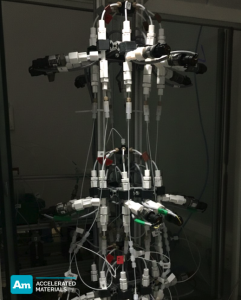
This question resulted in the development of a unique, robust parallel processing technology, which is embedded into our microreactor systems for gram-to-tonne scaling.
You can read more about one of our first industrial demonstrations of parallel processing with Shionogi & Co., Ltd at the Innovation Centre in Digital Molecular Technologies (iDMT), where we parallelized production of cancer drug intermediates with the reactor stack you see here (https://lnkd.in/g5KeGF7C).
What other ways can we improve the speed of materials scale-up and production?
Visit Accelerated Materials on LinkedIn