Laboratory automation and AI-assisted optimisation
AMLearn
From isolated instruments to smarter, connected R&D. AMLearn brings experiment control, workflow automation and adaptive machine learning into one environment. Give researchers a practical route from scattered equipment and disconnected data to more purposeful experimental campaigns.
Discuss AMLearn with an engineer
Challenge

Better equipment alone does not make a self-driving lab.

  • Disconnected lab instruments: Instruments with their own separate interfaces and manual hand-offs stop experiments from running as one connected workflow.
  • Repetitive experimental work: Scientists lose research time setting parameters, logging runs and repeating tasks instead of studying how materials behave.
  • Data without direction: Complex multidimensional data is hard to turn into the next experiment when you need to balance several targets at once.
Solution

From fragmented tasks to a connected R&D workflow.

  • Control the experiment: Run supported instrument functions, operating routines and scheduling from one app.
  • Learn from the results: Adaptive machine learning models explore your experimental space and pick out the most promising conditions to test next.
  • Make process knowledge usable: Keep experiment parameters and outcomes organised so teams can compare runs and make better development decisions.
  • Adopt automation progressively: Start by automating one workflow, then connect more instruments once compatibility and lab needs are confirmed.
Product configuration

Specifications that support an informed decision.

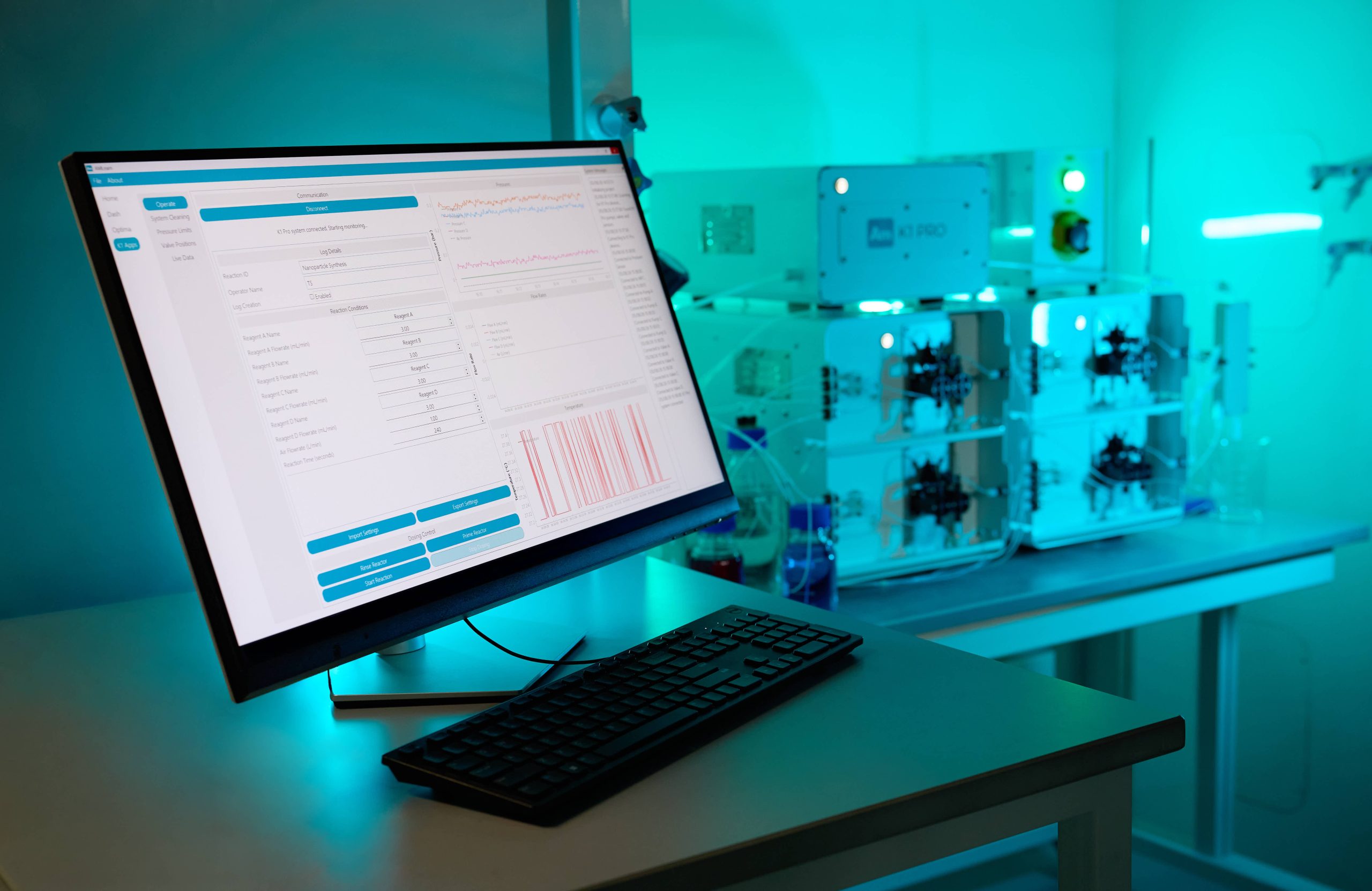
An operating system for running advanced lab equipment. It brings equipment control, lab automation and machine learning together in one platform. It includes apps for operating our equipment and machine learning tools for data analysis and reaction optimisation.

ModuleWhat it doesKey Capabilities
Dash: Equipment controlConnects to and controls your lab hardwarePrecision dosing, automated workflows, real-time monitoring
Optima: AI optimisationFinds the best reaction conditions using machine learningMulti-objective optimisation, solvent and condition prediction, drag-and-drop workflow design
K1 & K10 System ControlRuns and manages experiments on K1/K10 reactorsPrecision dosing, scheduling, real-time monitoring, recipe import and export, data reports
Capabilities and outcomes

Engineering features connected to results.

Best for industrial partners ready to commercialise validated nanomaterial synthesis at manufacturing scale.

Modular parallelisation

Scale manufacturing output without relying on a single oversized reaction volume.

Manufacturing integration

Support connected process control, auxiliary equipment and downstream manufacturing workflows.

Scale-up continuity

Carry forward validated synthesis requirements and critical quality targets from K1 and K10.
Next steps

Evaluate the product with your actual material.

Specify your target particle characteristics, existing method, material quantity and project timeline. AM can advise on fit, technical trials and procurement.

Request a technical meeting

Discuss reaction chemistry, available data and process objectives.

Plan a feasibility trial

Explore sample generation, quality criteria and pilot transfer.

Request a quotation

Scope hardware, software, controls and associated services.

Let's discuss your material

Know your target material. Not sure which reactor?

Speak with AM about your application, specification, stage and timeline. The initial discussion is the fastest route to the right technical scope.

Get in Touch

This field is for validation purposes and should be left unchanged.